








 English
 Français
 Deutsch
 Italiano
 Español

Non-fiction
Tecnologia
 Pubblicato 11 nov 2026
Aggiornato 11 nov 2026
 41 min

Non-fiction
Tecnologia
Pubblicato 11 nov 2026
Aggiornato 11 nov 2026
41 min


 All audiences
 Contribuisci
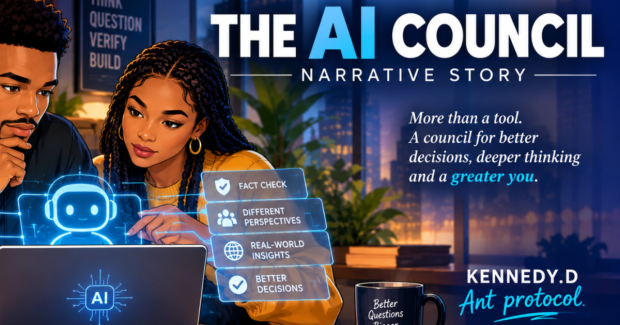
The AI Council - Conclusion & Practical Exercise
CONCLUSION
The Council Serves the Architect
Daniel returned to the first question.
Not the first question he had asked an AI assistant, but the question that had existed before he ever opened one.
What was he trying to build?
For months, he had examined artificial intelligence from different directions. He had explored its ability to investigate, analyse, challenge, verify, and organise information. He had learned to separate evidence from interpretation, disagreement from confusion, and confidence from certainty.
He had watched Marcus develop a business by testing assumptions against real customers instead of trusting a polished plan. He had watched Samuel replace the search for a perfect market prediction with a more disciplined examination of conditions, evidence, and risk.
And he had watched himself change.
At first, Daniel wanted better answers. Then he wanted a better system for producing them. Eventually, he realised that the system could be improved indefinitely while the person using it remained unclear about what mattered.
A powerful council could help someone move faster in the wrong direction.
It could make an uncertain idea look organised, an unsupported assumption sound reasonable, and a poor objective appear achievable. It could provide ten options to someone who had not decided what they were willing to sacrifice. It could even help a person explain a decision they had already made emotionally, giving the decision the appearance of careful reasoning.
The intelligence was useful.
But usefulness depended on direction.
Daniel opened his notebook and wrote:
The council serves the architect.
He stopped and considered the sentence.
The architect was not the person who knew everything. An architect could misunderstand a material, overlook a constraint, or design something that failed when exposed to reality. Good architecture required calculations, inspections, collaboration, and correction.
The architect's responsibility was not to perform every task personally.
It was to understand what was being built, why it was being built, what conditions it had to satisfy, and what consequences followed from the design.
That was the relationship Daniel wanted between human beings and artificial intelligence.
The machine could contribute extraordinary capability. It could process information, generate alternatives, identify patterns, simulate possibilities, and help examine the weaknesses of a plan.
But capability alone did not establish purpose.
A system could optimise a target without knowing whether the target deserved to be pursued. It could improve efficiency while increasing harm. It could maximise revenue while destroying the time and relationships that made the revenue worthwhile.
The calculation might be correct.
The objective might still be wrong.
That was why the human had to remain upstream.
Not because human judgment was infallible, but because responsibility could not be reduced to the production of an answer.
The Question Behind Every Question
Daniel began noticing a pattern in the decisions people brought to their AI assistants.
They asked how to become successful, but often had not defined what success meant.
They asked how to grow faster, but had not determined what growth would cost.
They asked which opportunity was best, but had not established which conditions they were unwilling to compromise.
They asked for certainty in situations where uncertainty was part of reality.
AI could help examine these questions. It could expose contradictions, challenge assumptions, and reveal consequences that a person had not considered. Sometimes, a carefully designed council could help someone discover that the original question was too narrow to support a good decision.
But the user still had work to do.
Before asking how to reach a destination, a person needed to examine the destination itself.
Before asking which path was most efficient, a person needed to determine what the path must preserve.
Before asking a machine to recommend a risk, a person needed to understand what losing would mean.
This did not require every human being to possess complete self-knowledge before using AI. Nobody begins with every answer. Priorities change, new information emerges, and circumstances force people to reconsider what they once believed.
The important thing was to make those judgments visible rather than allowing them to enter the system unnoticed.
A person could begin with an imperfect objective, provided they remained willing to examine it.
A council could help with that examination.
It could ask uncomfortable questions. It could compare a stated priority with the consequences of a proposed action. It could identify where the user's behaviour contradicted the user's own intentions.
It could even help someone recognise that the problem was not a lack of intelligence but a refusal to confront a difficult choice.
That was a valuable form of assistance.
Yet the final responsibility remained human: to decide what mattered, to revise those priorities when necessary, and to accept the consequences of acting on them.
Intelligence Without Surrender
Daniel thought about how easily people could mistake convenience for progress.
A person could use AI to write a message, organise a schedule, research a subject, analyse a business, or automate a repetitive task. These uses could save time and improve the quality of work.
There was no virtue in making a task unnecessarily difficult simply to prove that a human could do it alone.
The purpose of intelligence was not to preserve struggle.
It was to improve the relationship between effort and outcome.
But a person could also become dependent on the convenience itself.
They might ask AI to decide every small matter because choosing had become uncomfortable. They might repeatedly request reassurance until a preferred answer appeared. They might mistake a detailed explanation for a verified conclusion, or a confident recommendation for permission to ignore their own doubts.
Over time, the person could become less willing to exercise judgment without assistance.
The danger was not that the machine had become intelligent.
The danger was that the human had stopped practising the intelligence required to direct it.
Daniel did not conclude that every task needed to be completed manually or every decision needed to be reviewed through five separate roles. That would turn the council into another source of friction.
The appropriate method depended on the task.
A simple, reversible decision might require only a quick check. A significant commitment might justify a structured council review. A consequential decision involving safety, law, health, substantial money, or other people's rights could require authoritative sources, qualified professionals, and human oversight beyond anything an AI conversation could provide.
The point was to match the process to the stakes.
Use the machine where it adds capability.
Verify what must be established.
Consult people whose expertise or experience matters.
Keep uncertainty visible.
And never confuse delegation with the disappearance of responsibility.
A person who delegates a task should understand its boundaries. A person who automates a process should know what happens when the process encounters an exception. A person who accepts a recommendation should be able to explain why the recommendation fits the objective.
Human sovereignty did not require isolation from intelligence.
It required the ability to direct intelligence without surrendering judgment.
The Council Is Not the Evidence
There was another lesson Daniel wanted to preserve.
The council itself was not proof.
Five roles could produce five convincing reports and still share the same underlying error. Several AI systems could agree because they had relied on similar information. An investigator could retrieve a source without understanding its limitations. An analyst could calculate accurately from incorrect inputs. A challenger could overlook a weakness. A verifier could mistake repetition for independent confirmation. A synthesiser could make uncertain findings sound more settled than they were.
The names of the roles did not guarantee the quality of the work.
The process had to be examined.
That was why Daniel had learned to ask where a claim came from, what the evidence actually established, whether the sources were independent, and what remained unresolved. He had learned to distinguish a claim that was false from one that was simply unverified.
He had also learned that not every important question could be settled by factual evidence.
Evidence could help establish what happened, what something cost, whether a calculation was correct, or whether a proposed method worked under tested conditions.
It could not, by itself, decide what a person ought to value most.
A council could map the consequences of choosing income over time. It could compare the demands of two commitments. It could explain the risks of a business decision and identify the assumptions that remained untested.
But the human still had to decide which trade-offs were acceptable.
This boundary was not a weakness to be engineered away.
It was a necessary distinction between helping someone reason and claiming authority over that person's life.
Daniel wanted people to use AI boldly, but not blindly.
He wanted them to question it without dismissing its value, to benefit from its speed without treating speed as proof, and to accept assistance without abandoning the responsibility to think.
The strongest council would not be the one that always produced a single, confident answer.
It would be the one that helped the human see the problem more clearly—even when the clearest result was an unresolved question.
Building Beyond the Conversation
Daniel knew that the relationship between human beings and AI would continue to change.
Systems would become more capable. They would handle longer tasks, connect information across different tools, and carry out actions that previously required constant human attention. Some would monitor processes, identify emerging problems, and propose interventions before a person noticed that something had changed.
These capabilities could expand what individuals and organisations were able to accomplish.
They could also make it easier for decisions to happen without meaningful examination.
A system that recommends an action is one thing. A system that executes the action, changes other systems in response, and continues operating without clear boundaries introduces a different level of responsibility.
The question would no longer be only whether the answer was accurate.
It would also be whether the system had permission to act, whether its authority was limited, whether its behaviour could be inspected, and whether a person could intervene when circumstances changed.
Some tasks could reasonably be automated within defined limits. Others would require approval, independent checks, or the ability to stop the process before an irreversible consequence occurred.
The human role would not disappear simply because fewer individual actions required human attention.
It would move toward the design of objectives, boundaries, oversight, and correction.
That shift demanded more than technical skill. It required people to understand the systems they were building, the incentives shaping them, and the lives affected by their operation.
Daniel thought of Marcus's service business. Its future would not depend only on how many requests an AI system could process. It would depend on whether the service created genuine value, whether customers could trust it, whether providers were treated fairly, and whether the organisation could recognise and correct its own failures.
He thought of Samuel, who had learned that a market forecast was not an order from the future.
And he thought of himself, nearly accepting a project without defining the conditions under which the commitment would remain worthwhile.
In each case, the same principle had appeared in a different form.
Intelligence could widen the field of possible action.
Judgment determined which action deserved to be taken.
A Different Measure of Progress
Daniel returned to the beginning of his notebook.
He had once measured progress by the quality of the answer he received. A strong answer made him feel that he had moved closer to a solution.
Now he looked for something more.
Could he explain the decision?
Could he distinguish what he knew from what he assumed?
Could he identify the evidence that supported his conclusion?
Could he describe the important risks without pretending they had disappeared?
Could he recognise when he needed another person, a qualified expert, or a real-world test?
And if the council were unavailable tomorrow, would he still understand the problem well enough to continue?
These questions did not mean that every AI-assisted task had to become a lesson in independent thinking. Many tasks were routine, and the best outcome was simply to complete them well.
But for decisions that shaped his work, resources, relationships, and future, Daniel wanted assistance that strengthened his ability to act rather than making him dependent on the appearance of certainty.
He wanted to leave a conversation with more than an answer.
He wanted a clearer understanding of the situation, a better map of the available choices, and a defensible reason for choosing one path over another.
That was a more meaningful measure of progress.
Not the number of prompts used.
Not the number of AI systems consulted.
Not the length of the report.
Not even the confidence of the final recommendation.
The measure was whether the process helped produce a better-informed human decision—and whether the person making that decision remained capable of owning it.
The Architect and the Council
One evening, Daniel opened the first page of his manuscript.
He remembered the uncertainty that had started everything: a decision, a deadline, and a machine capable of producing an answer before he had fully understood the question.
He had imagined a council because one perspective was rarely enough. He wanted different roles, disciplined disagreement, independent verification, and a way to organise findings without confusing them with truth.
The idea had grown.
But the most important discovery had not been a clever prompt or an elaborate system of roles.
It was the boundary that made the entire arrangement useful.
The council could serve the architect only if the architect remained responsible for the design.
That responsibility included listening. It included revising a plan when evidence contradicted an assumption. It included asking for help, acknowledging uncertainty, and changing direction when reality demanded it.
It also included refusing a recommendation when the recommendation conflicted with a legitimate priority or rested on assumptions that had not been established.
Refusal was not proof of wisdom, just as agreement was not proof of error. The human could be wrong to reject sound advice.
What mattered was the quality of the judgment: whether the person understood the reasons, examined the evidence, considered the consequences, and remained willing to correct the decision when new information appeared.
The architect was not above criticism.
The architect was accountable for the structure.
Daniel closed his notebook.
He no longer needed the council to pretend that uncertainty could be eliminated. He needed it to help him navigate uncertainty with greater clarity. He did not need a machine to become the final authority over his intentions. He needed intelligence that could challenge those intentions, examine their consequences, and help him carry them into the world more effectively.
The council was ready to work.
The architect still had to decide what was worth building.
And that responsibility was not a limitation of intelligence.
It was the reason intelligence needed direction in the first place.
---
Here is the Practical Exercise formatted for strict Kindle flow reading. All tables have been removed and converted into clean, readable lists and text blocks to ensure it formats perfectly on any e-reader or phone screen.
---
PRACTICAL EXERCISE
Build and Test Your AI Council
From Understanding to Application
You have reached the point where understanding the principles is no longer enough.
You can agree that AI should not replace human judgment. You can recognise the danger of trusting a confident answer without verification. You can understand why different perspectives matter and why agreement between several AI systems does not automatically establish truth.
But what happens when you face a real decision?
Will you remember to challenge the recommendation when it agrees with what you already want? Will you distinguish evidence from assumptions when an opportunity looks attractive? Will you know when further investigation is necessary—and when you are simply delaying a decision because you want certainty?
The purpose of this exercise is to move those principles into practice.
You will build a simple AI council, use it to investigate a real decision, examine its findings, and make your own decision based on the evidence available.
You do not need five different AI applications. You do not need expensive software, technical knowledge, or a complicated workflow.
You need a decision worth examining, a willingness to question your assumptions, and the discipline to distinguish what the council says from what reality supports.
Your objective is not to make AI decide correctly for you. Your objective is to become better at making decisions with AI.
---
EXERCISE 1: Choose a Real Decision
Begin with a decision you genuinely need to make.
Choose something meaningful enough to benefit from careful analysis but manageable enough that you can investigate it without putting yourself or others at unnecessary risk.
Examples include:
· Deciding whether to accept a work opportunity.
· Evaluating a business idea before investing money.
· Comparing two ways to develop a skill.
· Determining whether a service provider is suitable.
· Planning a project with limited time and resources.
· Deciding how to improve an existing process.
· Evaluating whether a proposed purchase is necessary.
· Choosing the next step in a project that has stalled.
Avoid starting with an extremely broad question such as How do I become successful?
That question contains too many possible objectives, conditions, and interpretations.
Narrow it until the decision becomes clear enough to investigate.
Instead of asking: How can I build a successful business?
Ask: Should I test this service with ten potential customers before spending money on a full launch?
The second question gives the council something specific to examine.
Your Decision Record
Complete the following before consulting AI.
1. What decision am I facing?
Write the decision in one or two sentences.
---
2. Why does this decision matter?
Describe what could improve if you choose well and what could happen if you choose poorly.
---
3. What outcome am I trying to achieve?
Define the result you want rather than assuming that the most profitable, fastest, or easiest option must be the best.
---
4. What constraints must I respect?
Consider your available time, money, skills, responsibilities, and other practical limitations.
---
5. What am I unwilling to risk?
Identify any limits that should not be crossed merely to improve the expected outcome.
---
6. What do I currently believe is the best option?
Record your present opinion honestly.
---
7. What evidence supports my current belief?
Separate what you have observed or verified from what you have assumed.
---
Keep this record. You will compare it with your thinking at the end of the exercise.
The purpose is not to prove that your first judgment was wrong. It is to discover whether careful examination strengthens it, changes it, or reveals that you need more information.
---
EXERCISE 2: Build Your Council
You will now divide the investigation into five roles.
Each role has a distinct responsibility. The separation is intended to improve the process, not to create the illusion that five intelligent-sounding responses must produce the truth.
You may use one AI assistant and open separate conversations for each role, or use different systems if available.
When possible, avoid giving every role the same conclusion and asking each one to defend it. Let the roles examine the problem according to their responsibilities.
Role 1: The Investigator
Purpose: Establish what is known, identify relevant information, and find the claims that need examination.
Use this prompt:
«You are the Investigator in my AI council. Your responsibility is to investigate the decision I provide, identify the most important factual questions, distinguish established information from assumptions, and identify what evidence is missing.
Do not assume that my preferred option is correct. Do not invent facts or present unverified claims as established. Where current or external information is necessary, identify appropriate sources and distinguish information you have actually examined from information that still needs to be obtained.
Return:
1. The central facts currently available.
2. The important claims that require verification.
3. The assumptions embedded in my description.
4. The missing information that could materially change the decision.
5. The most useful next steps for obtaining that information.
If the available information is insufficient, state that clearly.
Here is my decision:
[Insert your Decision Record.]»
After receiving the response, ask yourself:
· Did the Investigator identify facts or merely repeat my description?
· Which claims have supporting evidence?
· Which claims still require investigation?
· Did the response introduce information that needs to be checked?
Record the findings.
Investigator's findings:
---
Claims requiring verification:
---
Role 2: The Analyst
Purpose: Examine the structure of the decision, including costs, benefits, assumptions, constraints, and possible outcomes.
Use this prompt:
«You are the Analyst in my AI council. Examine the decision and information provided without treating unverified assumptions as facts.
Analyse the mechanism by which the proposed option is supposed to produce the desired result. Examine costs, resources, dependencies, incentives, constraints, and possible outcomes.
Identify what must be true for the plan to work. Explain what could happen if the most important assumptions are wrong.
Where useful, compare alternatives and calculate scenarios using clearly stated inputs. Do not invent missing numbers. If a calculation depends on an assumption, label it.
Return:
1. The main mechanism behind the proposed plan.
2. The assumptions on which success depends.
3. The expected benefits and costs.
4. The most important dependencies.
5. Plausible alternative outcomes.
6. The information that would improve the analysis.
Here is the decision and the available information:
[Insert your Decision Record and relevant Investigator findings.]»
Examine the response.
A calculation can be accurate while its inputs are wrong. A plan can be internally consistent while relying on an unrealistic assumption.
Your task is to determine whether the analysis is grounded in information you can defend.
Analyst's findings:
---
Most important assumptions:
---
What must be true for this plan to work?
---
Role 3: The Challenger
Purpose: Test the reasoning by examining the strongest case against your preferred option.
This role must do more than generate a random list of dangers. It should identify weaknesses that could genuinely change the decision.
Use this prompt:
«You are the Challenger in my AI council. Your responsibility is to examine the strongest reasonable case against my preferred option.
Do not disagree merely to appear critical. Identify weaknesses, overlooked alternatives, conflicting objectives, hidden costs, and circumstances in which the proposed plan could fail.
Examine whether I have framed the question too narrowly or assumed that my preferred outcome is the correct objective.
Distinguish serious risks from remote possibilities. Do not claim that a risk will occur simply because it is possible.
Return:
1. The strongest argument against my preferred option.
2. The assumptions most likely to be wrong.
3. The most consequential failure scenarios.
4. An alternative explanation of the available information.
5. A lower-risk or more reversible approach, if one exists.
6. The evidence that would make you less concerned.
Here is the decision and the current analysis:
[Insert your Decision Record and relevant findings.]»
Do not automatically accept the Challenger's objections.
A negative answer is not necessarily more intelligent than a positive one. Fear can distort judgment just as optimism can.
Examine which objections are supported, which are plausible but unverified, and which are too remote to deserve much attention.
Challenger's findings:
---
The strongest objection:
---
Could I reduce the risk without abandoning the objective?
---
Role 4: The Verifier
Purpose: Examine important factual claims against appropriate evidence beyond the original AI responses.
This is where the council must confront the difference between a convincing explanation and a supported conclusion.
Use this prompt:
«You are the Verifier in my AI council. Your task is to examine the factual claims that could materially affect my decision.
Do not treat agreement among AI systems as proof. Do not assume that a source supports a claim simply because it is cited.
For each important claim, identify:
1. The exact claim being examined.
2. The evidence currently available.
3. The most appropriate source or method for checking it.
4. Whether the source directly supports the precise claim.
5. Whether other sources are genuinely independent or repeat the same underlying information.
6. What remains uncertain.
Distinguish between verified, partially supported, unverified, contradicted, and not applicable where appropriate.
Do not label a claim false merely because evidence is missing. Do not claim to have checked a source, record, or fact that you have not actually examined.
If you cannot access the necessary evidence, explain how I can verify it independently.
Here are the claims and findings to examine:
[Insert the important claims from the Investigator, Analyst, and Challenger.]»
Now perform the checks that matter.
Depending on the decision, this might involve examining an original document, reproducing a calculation, checking an official record, speaking directly with a relevant person, comparing actual prices, consulting a qualified professional, or running a limited real-world test.
Do not confuse searching for evidence with finding evidence.
Do not confuse a source that exists with a source that supports the claim.
And do not count several documents as independent confirmation until you understand where their information came from.
Verifier's findings:
---
Important Claim 1
Evidence examined:
Current status:
What remains uncertain:
Important Claim 2
Evidence examined:
Current status:
What remains uncertain:
Important Claim 3
Evidence examined:
Current status:
What remains uncertain:
Important Claim 4
Evidence examined:
Current status:
What remains uncertain:
If this list reveals that a critical claim remains unverified, do not quietly promote it to a fact in the final report.
Keep its status visible.
Role 5: The Synthesiser
Purpose: Organise the findings from the other roles without concealing disagreement or turning uncertainty into false confidence.
Use this prompt:
«You are the Synthesiser in my AI council. Organise the findings from the Investigator, Analyst, Challenger, and Verifier.
Do not introduce unsupported claims. Do not resolve disagreements merely to produce a neat conclusion. Distinguish factual findings, assumptions, interpretations, unresolved questions, and value judgments.
Return:
1. What is reasonably well supported.
2. What remains an assumption or uncertainty.
3. The strongest argument for each serious option.
4. The important disagreements between the roles.
5. The risks that could materially affect the outcome.
6. The next evidence-gathering step, if more evidence is needed.
7. The available actions, including delaying, testing, reducing the commitment, or declining.
Do not make the final decision for me. Explain the trade-offs so that I can decide.
Here are the findings:
[Insert the results of the four roles.]»
Read the synthesis carefully.
Does it preserve the limits identified by the Verifier? Does it represent the Challenger's strongest objection fairly? Does it distinguish a possible outcome from a predicted outcome?
If the report says that three roles support a proposal and one opposes it, do not assume that the majority must be correct.
The quality of the evidence matters more than the number of voices.
Synthesiser's findings:
---
What is reasonably well supported?
---
What could materially change the decision?
---
Which uncertainties remain unresolved?
---
EXERCISE 3: Challenge the Council Itself
Your council has now produced a report.
Do not make the decision yet.
First, examine the council's own process.
AI can make mistakes at every stage. It can misunderstand your objective, overlook an important constraint, produce faulty calculations, rely on weak sources, or summarise evidence too confidently.
The council's report is another object of examination, not an authority that exempts itself from scrutiny.
Answer the following questions.
1. Did I give the council enough information to understand the decision?
What important context might be missing?
---
2. Did I accidentally lead the council toward my preferred conclusion?
Did my wording assume that an option was correct, that a target was desirable, or that a particular outcome was inevitable?
---
3. Did the roles genuinely examine different responsibilities?
Or did each one repeat the same underlying information?
---
4. Which claims have been independently checked?
Name the claims and the evidence that supports them.
---
5. Which important claims remain unverified?
What would be required to investigate them?
---
6. Did the Synthesiser preserve disagreement?
Was any important objection removed, weakened, or presented as settled without sufficient evidence?
---
7. What could the council have overlooked?
Consider incentives, people affected, missing information, practical constraints, and consequences that are difficult to reverse.
---
8. What would make me change my current view?
Identify the evidence or conditions that would cause you to reconsider your preferred option.
---
If these questions reveal a weakness, return to the relevant role and investigate it.
You do not need to restart the entire process whenever a new question appears. Focus on the uncertainty that matters most to the decision.
The purpose of challenge is not to make the process endless.
It is to identify what deserves another look before you commit.
---
EXERCISE 4: Separate Evidence from Assumptions
Take the five most important claims in your council's report.
Write each claim in plain language.
Then classify its current status.
Use these working definitions:
· Verified to the required standard: Appropriate evidence has been examined and supports the precise claim sufficiently for the decision being considered. This does not mean absolute certainty.
· Partially supported: Some relevant evidence exists, but it does not establish the full claim or leaves important qualifications unresolved.
· Unverified: The claim has not yet been supported by sufficient evidence. It may be true or false.
· Contradicted: Reliable evidence conflicts with the claim as stated. Investigate whether the conflict can be explained before reaching a final conclusion.
· Not applicable: The statement is not a factual claim that can be verified in the same way. It may be a preference, objective, interpretation, or value judgment.
Claim 1:
Current status:
Evidence or reason:
Effect on my decision:
Claim 2:
Current status:
Evidence or reason:
Effect on my decision:
Claim 3:
Current status:
Evidence or reason:
Effect on my decision:
Claim 4:
Current status:
Evidence or reason:
Effect on my decision:
Claim 5:
Current status:
Evidence or reason:
Effect on my decision:
Now examine the list.
If a claim is unverified, does your preferred option depend on it being true?
If so, you may need further evidence before committing.
If a claim is only partially supported, can you narrow the decision so that it no longer depends on the unsupported part?
If evidence contradicts a claim, should you revise the plan?
If a statement expresses a value judgment, have you mistaken it for an objective fact?
These distinctions prevent the council from producing a polished conclusion that hides the weaknesses of its foundation.
Your task is not to make every claim certain. It is to understand which uncertainties matter.
---
EXERCISE 5: Make the Human Decision
You now have a clearer view of the available information, the strongest arguments, the unresolved questions, and the possible consequences.
It is time to decide.
Before doing so, close the AI conversations for a moment.
Return to your original Decision Record.
Read the objective and constraints you wrote before consulting the council.
Ask yourself whether they still reflect what matters to you. You may revise them, but identify why they need to change. Do not let the council silently replace them.
Then complete the following.
My Decision
What option am I choosing?
---
Why does this option fit my objective?
---
What evidence supports the decision?
---
What assumptions am I still relying on?
---
What risks am I accepting?
---
What risks am I unwilling to accept?
---
What would cause me to change course?
---
What is my next concrete action?
---
When will I review the result?
---
Your decision does not have to be a commitment to the entire plan.
You may choose to run a small test, seek professional advice, request more information, negotiate different conditions, postpone the decision, or decline the opportunity.
Sometimes the best next step is not to choose between two uncertain options. It is to design an experiment that makes the next decision better informed.
If you are considering a business idea, you might test whether a small number of customers will actually pay.
If you are evaluating a supplier, you might run a limited trial and record the full cost.
If you are considering a work commitment, you might negotiate a defined first phase before agreeing to a larger obligation.
If you are making a consequential decision involving health, law, safety, or substantial financial exposure, AI analysis should not replace the appropriate qualified professional or authoritative process.
The important thing is to match your commitment to the evidence and the consequences.
You are not required to eliminate uncertainty before acting.
You are required to understand what you are accepting.
---
EXERCISE 6: Return to Reality
A decision does not become correct simply because the reasoning was careful.
A well-designed council can still produce a poor outcome. A sensible decision can fail because circumstances change. A weak decision can succeed by luck.
That is why the process does not end when you choose.
It ends when you examine what happened and learn from the difference between your expectations and reality.
After taking your next action, return to this exercise and record the result.
1. What did I expect to happen?
---
2. What actually happened?
Record observable results rather than explanations you have not established.
---
3. Which assumptions were supported?
---
4. Which assumptions were wrong, incomplete, or still unresolved?
---
5. Did the council identify the important risks?
If not, what did it overlook?
---
6. Did I follow my own constraints?
Did I make the decision I intended to make, or did pressure, excitement, fear, or convenience change my behaviour?
---
7. What would I do differently next time?
---
8. What should I change in my council process?
Perhaps a role needs a clearer instruction. Perhaps a claim needs stronger verification. Perhaps you need to record your objective before asking for recommendations. Perhaps the decision requires input from someone with direct experience.
---
This final stage matters because your council should improve through contact with reality.
Do not judge it only by whether one decision succeeded or failed. Examine the quality of the process, the evidence available at the time, the risks you understood, and the information you gained afterward.
A sound process cannot guarantee success.
It can help you recognise why a decision was reasonable, where it was weak, and how to improve your next one.
---
THE AI COUNCIL — PERSONAL OPERATING CARD
Keep this short reference available when facing an important decision.
Before the Council
1. Define the decision.
2. State the outcome you want.
3. Identify your constraints and unacceptable risks.
4. Record your current assumptions and preferred option.
5. Decide how much verification the consequences justify.
During the Council
1. Investigate: What is known, and what needs to be established?
2. Analyse: How is the proposed outcome supposed to happen?
3. Challenge: What is the strongest reasonable case against my preferred option?
4. Verify: What evidence supports the important claims?
5. Synthesise: What is supported, disputed, uncertain, or dependent on my values?
Before Acting
1. Examine the council's assumptions.
2. Check important claims independently.
3. Preserve disagreements and uncertainty.
4. Compare the options against your own objective.
5. Decide whether to act, test, investigate further, seek expert advice, delay, or decline.
6. Record what would make you change course.
After Acting
1. Compare the expected result with reality.
2. Examine which assumptions held.
3. Identify overlooked risks and new information.
4. Improve the decision process.
Remember:
The Investigator does not establish truth merely by finding information.
The Analyst does not make a plan realistic merely by calculating it.
The Challenger does not become correct merely by finding weaknesses.
The Verifier does not eliminate uncertainty merely by examining sources.
The Synthesiser does not create certainty by organising the findings.
The council provides a disciplined way to examine a decision.
You remain responsible for the objective, the boundaries, the choice, and the consequences.
---
THE FINAL TEST
Imagine that tomorrow you lose access to every AI assistant you currently use.
You still have your knowledge, experience, judgment, responsibilities, and the world around you. You can still observe, ask people questions, examine evidence, perform calculations, consult experts, and test ideas.
Would you be able to continue working through your decision?
You might move more slowly. You might need help with tasks that AI previously handled. You might have to learn new methods or seek support from other people.
That is not failure.
The question is whether you understand the decision well enough to remain its owner.
If you cannot explain why you chose an option, distinguish your assumptions from established facts, or identify the conditions that would make you reconsider, then the council may have produced an answer without sufficiently strengthening your judgment.
Return to the parts you cannot explain.
Ask better questions. Examine the evidence. Clarify your objective. Consult someone with relevant expertise. Test the assumptions that can be tested.
Do not seek independence by refusing useful assistance.
Seek it by understanding how to use assistance without surrendering your capacity to judge.
The purpose of an AI council is not to make you unnecessary.
It is to extend what you can investigate, understand, and accomplish while keeping you accountable for what you choose to build.
The council can help you see further.
It cannot decide what deserves your life, your time, your resources, or your responsibility.
That remains the work of the architect.
---
The Council is built. The architecture is verified. But this is only the cognitive layer. The next phase requires something heavier: the human architecture. The discipline of the Forge.
If you want to follow this journey, follow the Architect. The next deployment is imminent.
Observed. Adapt. Build. Protect.





 Tecnologia











 Puoi sostenere i tuoi scrittori preferiti







Commento (0)