




 English
 Français
 Deutsch
 Italiano
 Español


Non-fiction
Health
 Published Jan 10, 2026
Updated Jan 10, 2026
Published Jan 10, 2026
Updated Jan 10, 2026
 4 min
4 min

Non-fiction
Health
Published Jan 10, 2026
Updated Jan 10, 2026
4 min





 Contribute
ADHD: The Cost of Regulation
What people see, and what they don’t
ADHD stands for Attention-Deficit/Hyperactivity Disorder.
That’s the official name. It doesn’t really capture what living with it feels like, but I understand the label: attention issues and hyperactivity are the most visible parts.
When I was a child, my teachers used to tell my mother during parent–teacher meetings that I was always “zoned out.” That I seemed somewhere else. Today, my friends call me Cloud, because I never quite feel here. My boyfriend often tells me that I look like I’m on another planet, and it’s not an exaggeration. If anything, I spend more time on other planets than on Earth, and I don’t like it.
My mind feels like it’s constantly switching channels, thought after thought, without any remote to control it. More often than not, I don’t choose my thoughts. They choose me.
That lack of control isn’t only mental, it’s physical too.
The hardest situations for me are the ones where I’m expected to sit still with no way out. Waiting in administrative offices. Being stuck in a car. Or worse, on a plane. When my body has no option to move, my entire system starts to feel trapped.
I need motion. I need stimulation. I need something to fidget.
So, to anyone who has ever had to sit next to me on a flight, I’m sorry. I will move. I’ll touch my hair, adjust my clothes, play with objects, do my makeup, anything. Anything except sitting still.
Because sitting still, for me, isn’t neutral. It’s unbearable.
But my attention problems and my hyperactivity are not the real disorder, they are the visible part of the iceberg. What’s actually broken runs deeper than that. The real disorder is regulation.
Regulation is what’s supposed to keep things in balance: thoughts, emotions, energy, movement, action. When it doesn’t work properly, everything comes in at once. I can be reading a message and suddenly remember something I forgot to do, notice a sound in the room, feel the urge to move, think about something unrelated, all at the same time. None of it is chosen. None of it waits its turn.
My thoughts interrupt each other. My emotions react before I’ve had time to place them. My body moves before I’ve decided it should. Starting something feels like pushing against an invisible wall, and stopping feels just as difficult, because there’s no clear signal telling me when to begin or when to let go.
Living like this is exhausting.
Not in a dramatic way, but in a constant, low-grade way. The kind of tiredness that comes from having to monitor yourself all the time.
I’m always adjusting. Slowing myself down. Speeding myself up. Trying to look normal. Trying to stay present. Trying not to drift too far, or react too fast.
And over time, that constant self-regulation turns into fatigue. And sometimes, into shame.
Because when you’re tired all the time, it’s easy to assume the problem is you. That you’re lazy. Unreliable. Too much. Not enough. You start questioning things that were never the issue to begin with.
What people don’t see is that this tiredness doesn’t come from doing nothing.
It comes from compensating, all day long, for what my brain fails at.
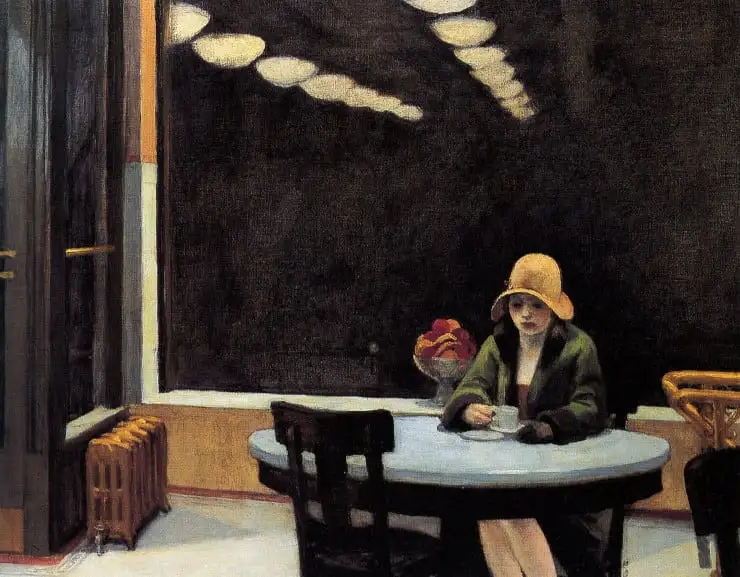
Edward Hopper, Automat (1927). Oil on canvas.
Edward Hopper. All rights reserved. Image reproduced for editorial and illustrative purposes.
In the next article, I’ll dive into ADHD from a neurological and scientific perspective, focusing on how the ADHD brain works. More articles will follow as part of this series, ADHD from the inside.
***
Disclaimer: This text reflects a personal and informational perspective and is not a diagnosis. Only a qualified healthcare professional can diagnose ADHD. If you have concerns or questions about ADHD, please seek advice from a medical professional.


Previus

Before We Begin





 Health









 You can support your favorite writers






Comments (3)
Franck Labat 5 months ago
As I suspected, total opposites ;-)
I spend my days on other planets, but boy do I love it! Could not survive without it (literally).
Still is my middle name, it's in stillness and quiet that I thrive.
Yet, same origins (regulation) and coping mechanism (compensation)... and is not compensating the worst energy sucker ever ?
Alban Vivicorsi 5 months ago
I understand everything even if I'm not fully like this. As for me, I need to create. I do my best everyday and create to feel better. AI helps a lot, from pictures to songs, I never miss an opportunity to make something. But I can't publish everything. 😅 I prefer to create than publish lol. "I don't shrink for your comfort, I expand what I see" seems to fit to feel better being ADHD (extract from a song I've got with AI).
Céline Hubert 5 months ago
Yes, creation helps a lot with ADHD. It’s a way to channel the energy, making something beautiful, and feeling productive.
Alban Vivicorsi 5 months ago
Yes. There's also the need to tell something and to feel understood. AI understand very well what I say. Humans have issues understanding what they've not experienced themselves.
Jackie H 5 months ago
in fact you have to do out of self-will things that should come by themselves automatically but don't because the "automatic system" is broken. Thus they require more effort than they should - and compete with tasks that require effort anyway, from just anybody. No wonder you're exhausted - and more than you should be with an *apparently* normal, or even less-than-normal, level of activity. My daughter has that problem. I suspect her parents, too 😉 but on a lesser scale 🙂.
My daughter says that the upside of ADHD is that it makes her good at multitasking (thus in a way better adapted to the modern world 🙂). Well there has to be some upside to it, hasn't it ? 😏
Céline Hubert 5 months ago
Thank you for your comment Jackie 😊 Yes, it’s often rapid switching rather than sustained focus, and it can also be a coping mechanism that helps us move forward instead of getting stuck. I might write more about this in another article 🙌🏼