








 English
 Français
 Deutsch
 Italiano
 Español


Non-fiction
Kultur
 Veröffentlicht am 11, Juli, 2026
Aktualisiert am 11, Juli, 2026
Veröffentlicht am 11, Juli, 2026
Aktualisiert am 11, Juli, 2026
 26 min

Non-fiction
Kultur
Veröffentlicht am 11, Juli, 2026
Aktualisiert am 11, Juli, 2026
26 min



 All audiences
 Beitragen
Xenia in the Ancient Greek World
ITALIAN VERSION HERE.
We wish here to sketch a brief historical-social outline of a concept foundational to ancient Greek civilization: xenia, ξενία. This term denotes the Greek conception of hospitality, objectified in the relationship between those who grant hospitality and those who are far from their own home, that is, strangers. The Greek term for the stranger is xenos, ξένος, sharing the same root as ξενία, and it denotes, with a broad semantic range, the guest, the stranger, the friend (not to be confused with philos, φίλος, i.e. friends belonging to the same community or kinship group), as well as the enemy. To be a stranger it was sufficient simply to belong to a different Greek state, or polis, πόλις. It should be recalled, in general terms, that Greek civilization had spread over a vast territory from the period of colonization, between 750 and 650 BC, which saw Greeks settle throughout the Mediterranean, from the Aegean lands of Greece and the Turkish coast as far as the Black Sea, Sicily, and southern Italy — the latter coming to be known, as is well known, as Magna Graecia. These distances, although experienced under the sign of a broadly shared cultural unity, gave rise to differing political conditions and differing worldviews. The polis, indeed, was a community that gradually took shape, over a long span of time, as an independent political entity, endowed with its own institutions and laws, corresponding to a defined and stable geographical space that comprised, broadly speaking, an urban centre, a rural territory, sanctuaries, borders, and so on. From this point of view it is worth recalling the figure of Cleisthenes (Κλεισθένης, 565–492 BC) [1], one of the fathers of democracy [2], an Athenian who, through his reforms, brought into being a polisorganised around a new, territorially based distribution of the population, with clearly defined roles, which subsequently served as a model.
The polis thus represented a self-contained microcosm, within which a citizen, once outside his own territory, could not feel himself legally guaranteed, not even with regard to his personal safety. This helps explain the need to establish relationships of mutual protection between persons from different cities, who were, in effect, strangers (ξένοι) to one another [3]. It should be borne in mind that we are still speaking within the context of a shared “Greek stock”; the Greek world, as is well known, also distinguished a further category of stranger: the “barbarian” (βάρβαρος, an onomatopoeic term well rendered as “stammering”), that is, one who did not speak Greek, or spoke it poorly, and who, precisely by virtue of being foreign, was regarded as a genuine outsider, both on the ethnic-cultural and on the political plane [4]. The “barbarian” stranger was often regarded as a threat — the Persians, for instance, were viewed in precisely these terms. Yet, thanks to the evolution of philosophical thought and to the radical shift in perspective brought about by the rise and dissolution of the empire of Alexander the Great (Μέγας Ἀλέξανδρος, 356–323 BC), Greece would come to establish a new relationship with neighbouring peoples — a reference here to the phenomenon of Hellenism [5].
A particular case of “guest” is represented by the metic (μέτοικος) [6], the resident foreign Greek living in a city-state for at least more than a month, who could remain there for a set period of time, up to roughly a year at most. At Athens, for example, the metic was required to register on a list [7] distinguishing him from citizens, to secure a prostates(προστάτης — proxenia being, in any case, itself a form of hospitality), a patron who would vouch for him, and to pay the metoikion (μετοίκιον), a direct personal tax unthinkable for a citizen; he was, moreover, barred from public and religious office. At Athens, metics thus occupied, in practice, an intermediate position between citizens and the unfree.
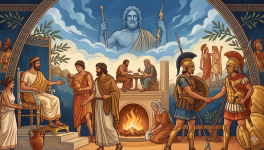
Returning to the theme of hospitality, it was realised through the reciprocal relationship between host and guest, and was expressed both through hospitality rituals — such as ablutions, banquets, and offerings to the gods — and through material benefits, such as the exchange of gifts, as well as immaterial ones, such as protection, shelter, or other forms of assistance. In other words, the guest had, first of all, the right to be received, attended to according to his needs (generally washed and anointed with oils), and fed. The importance of hospitality is further confirmed by the epithet given to the Greek god Zeus (Ζευς), Zeus Xenios (Ξένιος Ζευς), in his role as protector of guests, thereby embodying a religious obligation to show hospitality toward wayfarers. Further attesting to the sacred character of xenia is a recurring theme in Greek mythology, the theoxenia (Θεοξενίαι, literally “hospitality shown to a divinity”), whereby men demonstrate their virtue or piety by extending hospitality to a humble stranger (ξένος) who may then reveal himself to be a divinity (Θεός) in disguise, and who will repay the host’s gift — or his discourtesy — with a fitting recompense. The purpose of this motif was to warn mortals that every guest ought potentially to be treated as a divinity. This is one of the reasons why a wayfarer could resume his journey only after accepting, as the laws of hospitality required, a gift offered by the host, which the guest was not permitted to refuse. The gift, moreover, brought a gain in prestige at the cost of a material loss; to refuse it would have amounted to a refusal to acknowledge the prestige and social standing of the other party. Finally, the guest was bound to reciprocate the hospitality received, should the roles later be reversed and the former host find himself, as a wayfarer, in the house of his former guest.
It is above all in myth and literature — important sources of evidence alongside the historical record — that hospitality bears witness to its ancient roots. One cannot fail to recall the Homeric world, where we find episodes that help us understand the concept of hospitality in ancient Greece. First and foremost, the Trojan War itself, as narrated in the Iliad, comes to be configured as the result of a violation of the norms of xenia: Helen, the wife of Menelaus, is being hosted, together with her husband, by Paris, who seduces and abducts her, thereby gravely violating the bonds imposed by hospitality. In Book III of the Iliad, Menelaus, son of Atreus, invokes father Zeus, asking to be granted vengeance upon the one who first wronged him, that glorious Paris might fall by his hand, so that men yet to come might likewise fear to wrong a host who had received them in friendship [8]. He appeals to the god precisely because this violation, as noted above, constituted an affront also to the authority of Zeus Xenios (Ξένιος Ζευς), whom the Achaeans, obeying a religious duty of their own, were consequently bound to avenge.
The episode framing the tales told by Ulysses — his shipwreck and refuge at the court of King Alcinous, on the island of the Phaeacians — offers a clear illustration of hospitality as the Greeks conceived it. In Book VII, the elder Echeneus, a man versed in ancient lore and an eloquent speaker, is given the floor as guarantor of traditional wisdom: he urges Alcinous that it is neither fitting nor worthy of him that a guest should sit on the ground amid the ashes of the hearth, and that the king should have him raised up and seated upon a silver-studded throne, with the heralds ordered to pour wine so that libation might be offered to the Lord of the Thunderbolt, protector of suppliants, while the housekeeper serves the guest whatever the household affords. Alcinous accordingly repeats the order, instructing that the wine be mixed and shared among all present so that libation might be made to Zeus, lord of the thunderbolt, who protects and hallows suppliants, and announcing that the guest will be honoured in the palace with splendid sacrifices to the gods. Alcinous further allows for the possibility that the guest might himself be a god: were he indeed an immortal descended from the sky, he reasons, then the gods must be preparing something else again, since they are wont to show themselves visibly to men when sumptuous hecatombs are offered, seating themselves beside them at the banquet [9].
One may also recall the exemplary episodes of Glaucus and Diomedes, and of Achilles and Priam. In the first, narrated in Book VI of the Iliad, Glaucus, facing Diomedes in battle, discovers an ancient bond of hospitality between them — hereditary, indeed, since each recognises the other as a guest-friend through the ties once shared by their fathers — and the two refuse to fight, exchanging their armour instead, according to the ritual of the gift. In the second episode, in Book XXIV of the Iliad, Priam, king of Ilium, accompanied only by an old servant and bearing a great quantity of gifts as ransom, and aided by the god Hermes, makes his way secretly into the enemy camp, into Achilles’ tent, and kneels at the hero’s feet to implore his mercy; Achilles is moved and grants him hospitality, and after offering a meal in Priam’s honour, restores to him the body of Hector.
In the Odyssey we find the endless banquet offered by the god Aeolus, extended also to the hero: Ulysses and his companions reach the Aeolian island, home to Aeolus, son of Hippotas, dear to the immortal gods, where the household feasts without end, abundant food set before them, the house perpetually fragrant with roasted meat, its courtyard resounding — and for a full month Aeolus plays host to Ulysses [11]. Yet hospitality is not always deserved, particularly once a promise has been broken: Ulysses proves unable to prevent his companions from opening Aeolus’s gift, a bag containing all the winds; after the storm that follows, he finds himself back on Aeolus’s island, only to be driven away, as Aeolus tells him to leave at once, the most despicable of men, since it would be wrong to offer aid and escort to one hated by the blessed gods, his very return being proof of the immortals’ enmity toward him [12].
Also significant is the hospitality of the swineherd Eumaeus, who shares a simple meal with the stranger whose identity he does not yet know, telling him that it is not his custom to treat a guest badly, however wretched he may be, since strangers and beggars alike are sent by Zeus, and that the gift he can offer, though small, is sincerely given [13]. Later, Ulysses himself is recognised by his old nurse Euryclea while she carries out one of the customary rites of hospitality, the washing of the guest’s feet, as Penelope has ordered: the guest’s feet are to be washed, and wise old Euryclea is bidden to rise to the task despite her failing strength; as she washes him, she at once recognises the scar left long ago by a wild boar’s white tusks [14]. Finally, Ulysses’s own act of vengeance is motivated not only by the suitors’ designs upon Penelope, but also by their grave violations of the bonds of hospitality — not least their failure to honour him when he presented himself as an anonymous beggar. Prince Antinous, indeed, had insulted him and struck him on the back with a stool [15] when he appeared in the wretched garb of a mendicant. Here the theme of theoxenia returns, for Antinous is reproached by the other suitors, who are well aware that a god might be concealed behind the beggar’s appearance [16], in one of those frequent divine epiphanies meant to observe men’s conduct, whether to punish or reward it. It is likewise for this reason that, before beginning the slaughter, Ulysses appeals to the gods, addressing the suitors as dogs who never imagined he would return home from the Trojan land, who have devoured his substance, forced themselves upon his serving-women, and courted his wife while he yet lived, fearing neither the gods who hold the vast heaven nor the eventual vengeance of men [17].
This concept, then, is deeply rooted, culturally, in the very foundations of Greek identity, even before that identity had been fully articulated in its political and social dimension. It would remain a permanent feature of the forma mentis of the Greek, throughout all phases of Greek political life — whether under the tyrannies, in the formation of the democratic poleis, or during the formal unification brought about by the Macedonian crisis. It is worth briefly recalling, in this connection, the eventual outcome of Macedonian influence, realised in 337 BC through a Panhellenic alliance known as the League of Corinth. This alliance was of epoch-making importance, insofar as it can be regarded as the first genuine attempt to overcome the historic fragmentation of the poleis. It should be noted that, before the formation of the League of Corinth by King Philip II (Φίλιππος Β’ ο Μακεδών, 382–336 BC), the Macedonians — although probably speaking a dialect of Greek origin — were not regarded by the other poleis as a people belonging to Hellenic culture and tradition, but rather as “barbarians”, lacking any form of government based on the polis and ruled instead by an absolute monarchy.
Membership in the League was imposed upon the poleis as a consequence of their defeat at Chaeronea in 338 BC. The Macedonian king, through the Peace of Corinth [18], dissolved all existing unions among the city-states and established a new pact that granted primacy to Macedon, under which the poleis pledged mutual peace. The League presented itself, one might say in modern terms, as a federal state of free cities, but in fact it was headed by the king of the Macedonians, who retained the ability to intervene in the internal politics of individual cities.
Sparta was the last to submit to the League of Corinth, under Alexander the Great, following its defeat by Antipater at Megalopolis in 331 BC. A further impetus toward this decision came from the prospect of a new war against Persian power, which — it is worth recalling — had already, during the Persian Wars (499–479 BC), indirectly helped to forge Greek identity and the cooperation necessary among the poleis.
Returning to the central theme of our discussion, hospitality clearly also carried significance in terms of representation and political honour. At Athens, for example, the prytaneion (πρυτανεῖον) was a public building that originally housed the chief magistrate (πρύτανεως, the prytanis); within it was kept the city’s sacred hearth, where guests of particular distinction or citizens who had rendered outstanding service were received [19]. Vernant observes, in this connection, that the invitation to dine in the prytaneion constituted a form of xenia through which foreign ambassadors, returning Athenian embassies, and more generally all those whom the city wished to honour were shown esteem; such privileges, he notes, came to be extended and employed with increasing frequency during the fourth century, becoming part of the regular honours which the citizen assembly would periodically decide to bestow upon the city’s benefactors — a newly enfranchised citizen, for instance, would be invited to dine in the prytaneion, and toward the end of the fourth century there arose the possibility of a permanent, and at times even hereditary, right known as sitesis [20].
The one who held the honour and the right — sitesis (σίτησις, meaning “provisions”) — to sit among the permanent guests of the prytaneion was called a parasitos (παράσιτος), from the verb παρα-σιτέω, “to eat alongside”; the term originally denoted chiefly the “table-companion”, one who eats at his host’s expense yet brings him no real harm — indeed, who may bring the host credit, as was the case with poets [21]. In a certain sense, these were citizens maintained at public expense, as was, for example, Cleon (?–422 BC), who was granted this privilege of maintenance after the victory over the Lacedaemonians at the Battle of Sphacteria in 425 BC, during the Peloponnesian War [22]. From this practice of public maintenance, the term would go on, in the Latin period, to acquire negative connotations. Evidence of this is provided by Lucian of Samosata (Λουκιανός ὁ Σαμοσατεύς, c. 120 – c. 186), whose work De parasito attests to the pejorative use of the word, also reflected in the derivative parasitia, “the art of the parasite, base flattery”.
Let us bring this brief survey of the topic to a close. By way of conclusion, we would like to recall an anthropological aspect — indeed, an anthropological constant [23] — of xenia, one which, as we have seen, ancient Greek civilization put firmly into practice. As has repeatedly been shown, hospitality presupposes a reciprocal exchange of gifts. At this point one cannot fail to think of a foundational and by now classic work, the Essai sur le don [Essay on the Gift] of the French anthropologist Marcel Mauss (1872–1950) [24]. The theory the author sets out arises from the comparison of various ethnographic studies, among them Franz Boas’s (1858–1942) study of the potlatch ritual and Bronisław Malinowski’s (1884–1942) study of the Kula ring. In brief, the exchange of goods, even of goods of no great intrinsic value, is one of the most common and universal means of forging human relationships — and also of building bridges with the divine. If we think about it, what else is a sacrifice or an offering to a divinity, if not a gift from which one expects to be repaid with the divinity’s benevolence?
Mauss identifies three fundamental moments in the mechanism of the gift, grounded in the principle of reciprocity: to give; to receive (the object must not be refused); to reciprocate. For Mauss, the binding, obligatory character of these exchanges derived from an intrinsic quality of the gift itself, constituted by the “magical” force of the one who had given it up — an idea he arrived at through his study of the hau, the spirit of the given thing, as understood among the indigenous Māori of New Zealand. If the balance was not restored through reciprocation, the exchange would be broken off, and that force would turn against the transgressor.
To be sure, Mauss’s conclusion appears somewhat weak — as Claude Lévi-Strauss (1908–2009) himself recognised, holding instead that such exchanges arise from unconscious principles: the fact that Mauss had adopted an indigenous theory as an explanation of the phenomenon represented, for Lévi-Strauss, both a step forward and a limitation, since, in his view, the ultimate reason for exchange could not lie in the hau and in what it threatens.
NOTES
[1] Few figures in Greek history played a role of comparable importance to that of Cleisthenes, whose radical transformation of Athenian institutions gave rise to the Greek world’s first experience of democracy. Cleisthenes introduced a new territorial and administrative organisation of Attica aimed, it appears, at securing equal rights of political participation for all citizens (isonomia) and at curbing the dominance of the great aristocratic families over the political life of the polis. At the heart of the Cleisthenic system lay a new division of the citizen body into ten territorial tribes, replacing the traditional four kinship-based ones; each tribe was formed from three districts (trittyes) — one urban, one coastal, one inland — so as to be representative of every part of Attica, thereby limiting the ability of any single aristocratic faction to dominate a given tribe through local power and clientelistic ties. Mauro Corsaro, Luigi Gallo, Storia greca, Mondadori, 2010.
[2] Demos–demokratia. Already attested in the Mycenaean period (the Linear B tablets record the term damo, denoting both a district of a kingdom and the community settled there), demos could designate either the whole community or, more specifically, its socially defined common element, as opposed to groups of higher standing. A similar duality attaches to the compound demokratia: democrats used it to describe a constitution in which power rested with the whole community rather than with one part of it, whereas thinkers of oligarchic leaning identified demokratia with the dominance of the propertyless, and hence with a regime governed by the least qualified segment of the citizenry. The term is first attested in Herodotus’s Histories (second half of the fifth century); at the time of Cleisthenes’ reform, the democratic watchword was most likely not yet demokratia but the older term isonomia, denoting a political order in which all citizens enjoy equal rights of participation. Mauro Corsaro, Luigi Gallo, Storia greca, Mondadori, 2010.
[3] The stranger (xenos) possessed, so to speak, no rights once outside his own homeland; but the ancient traditions of hospitality (xenia), vividly illustrated by the aristocratic figures of Homer, together with the practical necessities of exchange, contributed to the development of customary international norms. Francois Lefèvre, Storia del mondo greco antico, Einaudi, 2012.
[4] The relationship between Greeks and barbarians is a markedly prominent theme in Greek history, and helped to construct the very identity of the former in contrast to the latter. From the Persian Wars onward, the ethnic term “Hellenes” gained particular weight and significance precisely through the forced confrontation with the Persian enemy, perceived as irremediably alien in both culture and law. From that point on, the Greeks learned to look to “others” in order to affirm their own superiority, their vocation for freedom, and their innate inclination toward order and communal organisation; the confrontation in fact led to a definition of the Greek self. Federica Cordano, Le parole chiave della storia greca, Carocci, 2008.
[5] Partly owing to the more advanced currents of philosophical thought, the fifth and fourth centuries saw the emergence of a somewhat less prejudiced attitude toward barbarians. Xenophon, a contemporary historian, could celebrate the young Persian prince Cyrus as the perfect model of the “cultured Greek” — a barbarian capable of acquiring a second, Greek nature through healthy and productive cultural exchange. The fourth-century orator Isocrates took a similar position, maintaining that Greekness was not an ethnic but a cultural fact. With Hellenism, a new relationship with foreigners emerged, including the translation of Jewish, Libyan, and Asian texts, in an effective, if imperfect, globalisation avant la lettre. Federica Cordano, Op. cit.
[6] Entry consulted in the Dizionario di storia Treccani, Istituto dell’Enciclopedia Italiana, 2010.
[7] An Athenian declared his identity by giving his name, his father’s name (patronymic), and above all his deme, which he retained even if he changed his place of residence; metics (resident foreigners) were likewise required to register within a deme of residence. Francois Lefèvre, Storia del mondo greco antico, Einaudi, 2012.
[8] Omero, Iliade, III, a cura di Maria Grazia Ciani, Marsilio, 1990.
[9] Omero, Odissea, VII, a cura di Maria Grazia Ciani, Marsilio, 1994.
[10] On the bond of hospitality see also Herodotus, Storie, II, 182; IV, 154; V, 63 in particular notes that the bond could be broken in the face of a divinity’s will.
[11] Omero, Odissea, X, cit.
[12] ivi.
[13] Omero, Odissea, XIV, cit.
[14] Omero, Odissea, XIV, cit.
[15] Omero, Odissea, XIV, cit.
[16] Omero, Odissea, XVII, cit.: another suitor rebukes Antinous for striking an unfortunate wanderer, warning him that the victim might be one of the heavenly gods in disguise, since the gods — resembling strangers from other lands and assuming various forms — are said to go about the cities to see whether men act justly or unjustly.
[17] Omero, Odissea, XXII, cit.
[18] Cfr. Mauro Corsaro, Luigi Gallo, Storia greca, Mondadori, 2010, Cap. 3.5.
[19] Erodoto, Storie, I, 146; III, 57; V, 67; VII, 197.
[20] Jean-Pierre Vernant, L’uomo greco, Laterza, 1997.
[21] Dalla voce “parassiti”, Enciclopedia della scienza e della tecnica Treccani, Istituto dell’Enciclopedia Italiana, 2007.
[22] Domenico Musti, Storia Greca, Laterza, Bari, 2001.
[23] We may recall here the studies of Carl Gustav Jung (1875–1961) on the archetypal — that is, on all those motifs which, recurring constantly, give shape to fundamental aspects of human existence, pointing back to primordial images and original patterns of behaviour. Such archetypal constants, when found within literary texts, express connections that are profound and universal to humankind.
[24] Marcel Mauss, Saggio sul dono, in Teoria generale della magia e altri saggi, Torino, Einaudi 1965.
ITALIAN VERSION HERE.






 Kultur
























 Du kannst deine Lieblingsautoren unterstützen








Kommentar (0)